There is a special feeling every developer knows. You open code you wrote six months ago and think: “Who wrote this garbage?” Then you check the git blame. It was you. It is always you.
Good news: that feeling means you are getting better. If your old code never embarrasses you, you have probably stopped growing. Here is what actually helped me level up, from WordPress themes and PHP back-ends to React apps and real-time 3D, minus the motivational-poster fluff.
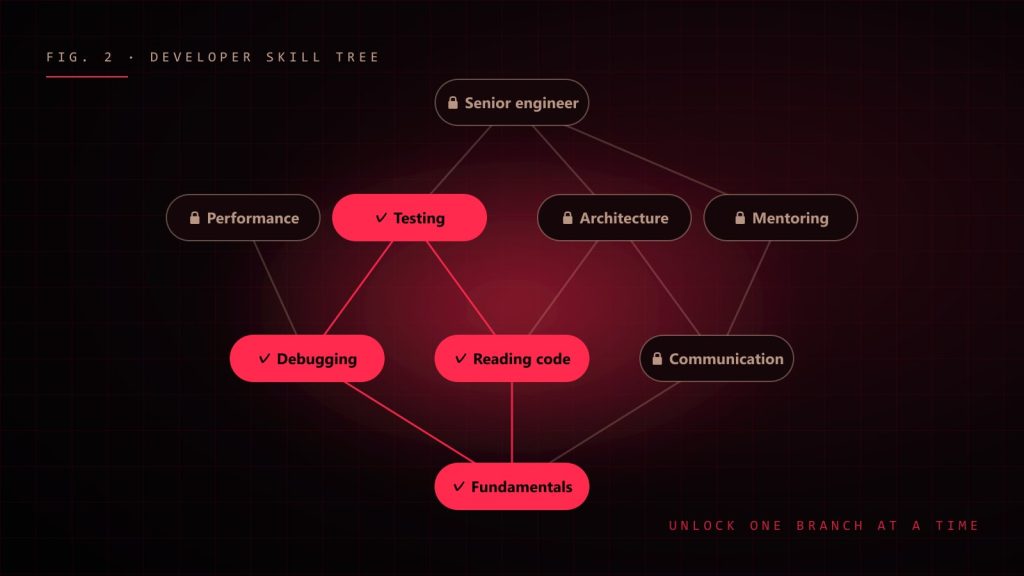
1. Learn the fundamentals, not just the framework
Frameworks come and go. I have watched jQuery rule the world, then politely leave the room. The things that stayed useful through every trend: how the browser renders a page, how HTTP works, how JavaScript handles async code, how data flows through an app.
When you understand the fundamentals, a new framework is just new syntax for ideas you already know. When you don’t, every new framework feels like starting from zero.
2. Read more code than you write
Writers read books. Developers should read code. Open the source of a library you use every day. Read the pull requests of the best engineer on your team. You will steal (I mean, “learn”) patterns, naming habits and clever ways of handling edge cases that no tutorial teaches.
3. Build things that are slightly too hard
Tutorials feel productive, but they are like watching cooking shows: entertaining, educational, and you still can’t make dinner. Real growth happens when you build something just beyond your comfort zone and have to figure it out yourself.
- Never built a real-time app? Make a tiny chat with WebSockets.
- Curious about 3D? Put a rotating cube on a page with Three.js, then make it react to the mouse.
- Only done front-end? Write the API for your own side project.
You will get stuck. That is the part where the learning happens.
4. Get good at debugging
Debugging is the most underrated developer skill. Bad debugging is changing random things until the error goes away. Good debugging is a calm, boring, scientific process:
- Reproduce it. If you can’t make it happen on purpose, you can’t prove you fixed it.
- Read the actual error message. All of it. Yes, even the scary part.
- Form one hypothesis and test it. Change one thing at a time.
- Shrink the problem. Remove code until the bug disappears; the last thing you removed is your suspect.
- Write down the fix and the cause. Future you will hit the same bug. Future you deserves notes.
5. Ask for feedback (and survive it)
Code review comments can sting. “Why is this 400 lines?” feels personal. It isn’t. Treat every review as a free lesson from someone who spent their time on your growth. Ask senior developers “how would you have done this?” Most of them love answering, and you get years of experience in a ten-minute chat.
6. Write things down
Keep a simple “today I learned” file. Write short notes after solving a tricky problem. Explain things in a blog post, even if only five people read it. Explaining something is the fastest way to discover you don’t understand it yet, which is the first step to actually understanding it.
7. Care about the user, not just the code
The best developers I know don’t only ask “does it work?” They ask “is it fast on a cheap phone?”, “can someone use it with a keyboard?”, “will this confuse a new user?” Caring about the person on the other side of the screen turns a coder into a product engineer, and product engineers are the ones teams fight to keep.
8. Protect your energy
You can’t become a great developer while running on four hours of sleep and pure panic. Take breaks. Go outside. Close the laptop at a reasonable hour. Some of my best solutions arrived in the shower, on a walk or while washing dishes, never while staring harder at the screen.
A simple weekly plan
- One hour reading good code or docs.
- One small experiment with something you don’t know yet.
- One note about something you learned.
- One question to someone more experienced.
It doesn’t sound like much. Do it every week for a year and you won’t recognise your own code. Which, as we established, is exactly the point.
Leave a Reply