A few years ago, “AI writes code” sounded like science fiction or a sales pitch. Today, an AI assistant suggests the rest of my function before I have finished typing its name. Sometimes it is brilliant. Sometimes it confidently invents an API that has never existed, in a tone so sure of itself that I briefly doubt my own memory.
So, is AI going to replace programmers? Make us ten times faster? Turn us into prompt typists? After using AI tools every day in real projects, my honest answer is: it changes the job a lot, but not in the way the headlines suggest.
What AI is genuinely great at
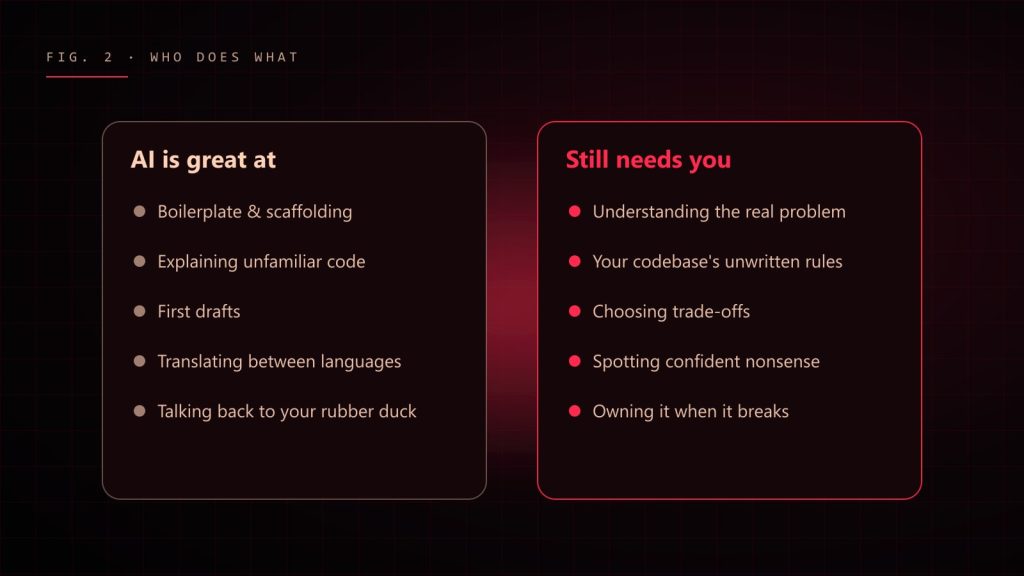
Let’s give credit where it is due. AI assistants are excellent at:
- Boilerplate. Form validation, API types, test scaffolding, the fifteenth CRUD endpoint. Things you know how to write but would rather not.
- Explaining unfamiliar code. “What does this regex do?” used to mean twenty minutes of squinting. Now it is a question.
- Getting unstuck. A blank page is the hardest part of any task. A rough first draft, even a wrong one, gets your brain moving.
- Translating between languages and frameworks. “Here is this function in PHP, give me the TypeScript version” is a solid time saver.
- Rubber ducking that talks back. Explaining a bug to an AI often makes you spot it yourself, just like the classic rubber duck, except this duck has opinions.
What still needs a human
AI is a very fast, very well-read intern with no context, no memory of your last architecture meeting and absolutely no fear. That combination is powerful and occasionally terrifying. It struggles with:
- Understanding the actual problem. It answers the question you asked, not the question you should have asked.
- Your codebase’s unwritten rules. Why that service is never called directly, why the date field is stored as a string, why nobody touches
legacy-utils.js. - Trade-offs. It can list options. Choosing the right one for your team, budget and deadline is still your job.
- Being wrong quietly. When AI is wrong, it is wrong with perfect grammar and great confidence. That is the dangerous part.
The skill that matters more now: reading code
If AI writes more of the first draft, the human job shifts toward reviewing, testing and understanding. You become an editor more than a typist. That means the developers who benefit most are, ironically, the ones who already know their fundamentals well. You cannot spot a subtle bug in generated code if you don’t understand what correct code looks like.
My rule: never commit code you could not explain to a teammate. If the AI wrote it and you can’t explain why it works, you don’t have a feature. You have a mystery with a deadline.
How I actually use AI day to day
- Give context. Paste the relevant types, the error and what you expected. “Fix my code” gets generic answers; “this hook re-renders on every keystroke, here is the component” gets useful ones.
- Ask for options, not answers. “Give me two approaches and their trade-offs” leads to better decisions than “write it”.
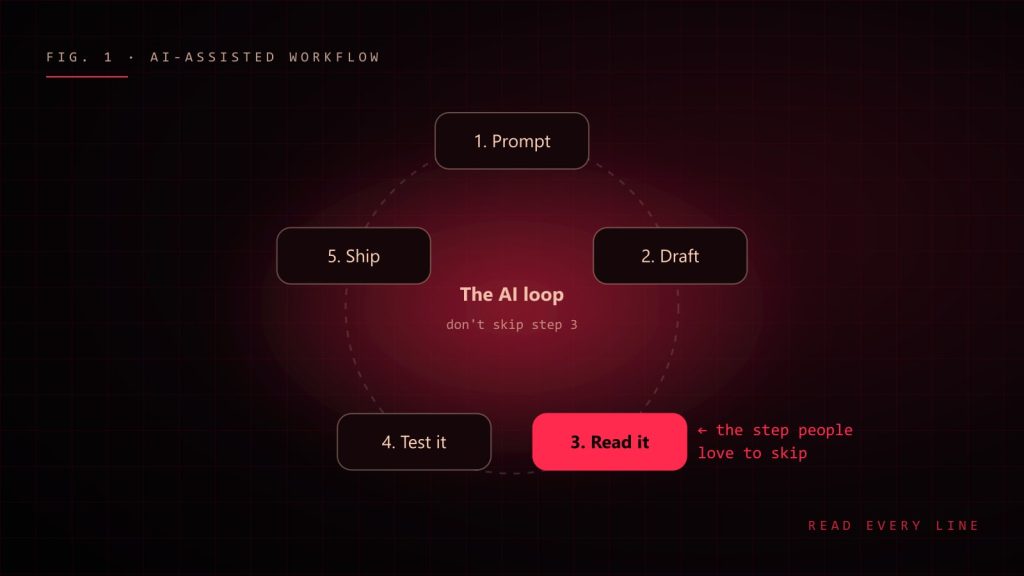
- Read every line. Especially imports, edge cases and anything touching money, auth or user data.
- Test it. Generated code deserves the same tests as hand-written code. Possibly more.
- Keep secrets out. Never paste API keys, passwords or private customer data into a prompt.
Weak prompt:
  "make this faster"

Better prompt:
  "This React list re-renders all 2,000 rows when one item changes.
   Here is the component and the store. Suggest two fixes, explain
   the trade-offs, and don't change the public props."
Will AI replace developers?
It will replace some tasks developers do. It already has. Nobody misses hand-writing the same form validation for the hundredth time. But software is not just code; it is understanding people, untangling vague requirements, making trade-offs and taking responsibility when things break at 2 a.m.
The developers I worry about are not the ones using AI. They are the ones who refuse to learn it, and the ones who use it without understanding what it produces. The sweet spot is in the middle: use AI to go faster, and use your brain to go in the right direction.
Advice for people starting today
- Learn the fundamentals properly. They are how you judge what the AI gives you.
- Use AI to explain things, not just to do things for you.
- Build real projects. AI can help write code; it cannot give you the experience of shipping and supporting something.
- Practise reading other people’s code. In the AI era, that is half the job.
AI did not end programming. It removed some of the boring parts and raised the bar for the thinking parts. Honestly? That’s a pretty good deal. Just double-check the imports.